AAMU Engineering Professor Shares Experimental Findings on Spacetime Distortion During Strategic Research Briefing
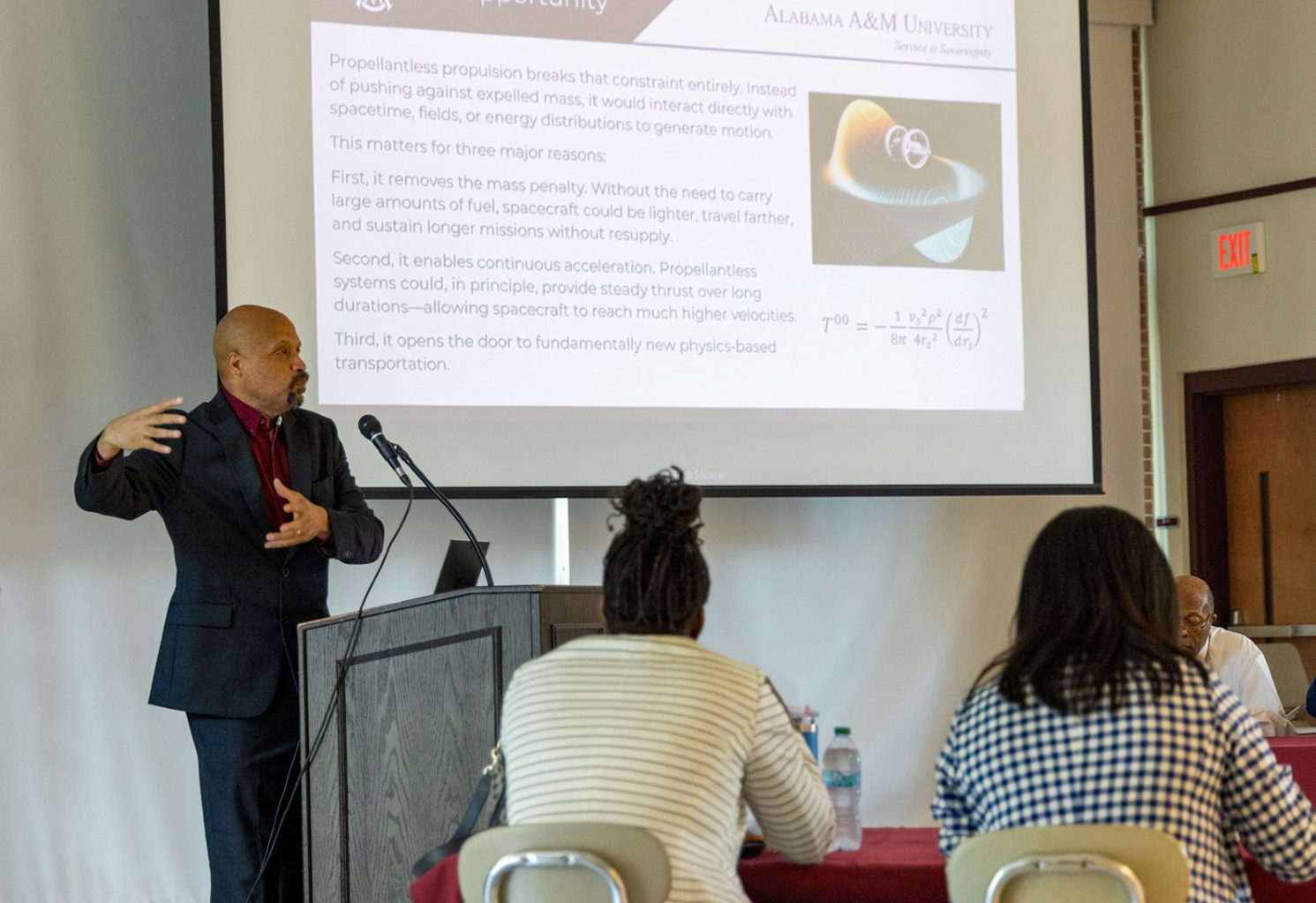
Glenn Presents Advanced Propulsion Research to U.S. Space Command
As U.S. Space Command expands its presence in Huntsville, Alabama A&M University researchers are helping demonstrate how the University's expertise can contribute to the nation's future defense and space priorities.
During a recent strategic briefing between Alabama A&M University and U.S. Space Command, Dr. Chance Glenn Sr., professor of electrical engineering in the College of Engineering, Technology and Physical Sciences, presented research exploring experimental methods for generating spacetime distortions and gravitational wave effects in a laboratory setting. The meeting marked the first formal engagement between AAMU researchers and Space Command officials as the command prepares to establish its permanent headquarters at Redstone Arsenal.
The briefing highlighted Alabama A&M's growing research portfolio and its potential role in supporting national security, advanced technology development and workforce preparation in North Alabama's rapidly expanding aerospace and defense sector.
Glenn's presentation focused on findings from his recently published research examining whether high-energy-density fields generated through electrically driven spark gaps can produce measurable spacetime distortions. Using laser interferometry, the study observed fringe movement patterns that correlated with spark power, distance, orientation and pulse repetition frequency, suggesting the possibility of gravitational wave-like effects under controlled laboratory conditions.
The research, published in the European Journal of Engineering and Technology Research, investigates concepts that could eventually inform future advancements in propulsion systems, communications technologies and other aerospace applications. The study also proposes a theoretical framework known as “gwavelets” phased arrays, which could provide new approaches for shaping and manipulating gravitational waves.
“Research that challenges existing assumptions often begins with asking questions others have not explored,” said Glenn. “Our work seeks to better understand the relationship between high-energy-density fields and spacetime, while identifying potential applications that could benefit future generations of aerospace and defense technologies.”
Glenn's research has been supported in part through a National Science Foundation Small Business Innovation Research grant and is conducted in collaboration with Morningbird Space Corporation, an aerospace research company he founded to advance emerging technologies in space exploration and propulsion systems.
The Space Command briefing featured presentations from several Alabama A&M research leaders, including Dr. Majed Dweik, vice president for Research and Economic Development; Dr. ZT Deng, dean of the College of Engineering, Technology and Physical Sciences; Dr. Timothy Mantz, executive director of the AAMU-RISE Foundation; and Dr. Paul Ruffin, chief scientist of the RISE Foundation.
Leading the discussion for U.S. Space Command was Richard Fierro, Joint Training Manager supporting the Academic Engagement Enterprise, along with senior officials responsible for training, education and academic engagement initiatives.
The engagement comes at a pivotal time for Huntsville's defense and aerospace community. With approximately 1,400 personnel expected to transition to Redstone Arsenal in the coming years, U.S. Space Command's growing presence is creating new opportunities for collaboration among military, industry and higher education partners.
For Alabama A&M, the meeting underscored the University's commitment to conducting research that addresses complex scientific challenges while preparing students to contribute to the nation's aerospace, defense and technology workforce.
Photo by Shannon Schmalfeldt