Advancing Semiconductor Innovation for Defense, Aerospace and Space Technology
AAMU Researchers Demonstrate Advanced Microelectronics Expertise to U.S. Space Command
As the nation invests in strengthening its semiconductor supply chain and advancing next-generation defense technologies, Alabama A&M University researchers are helping position the University as a leader in microelectronics innovation.
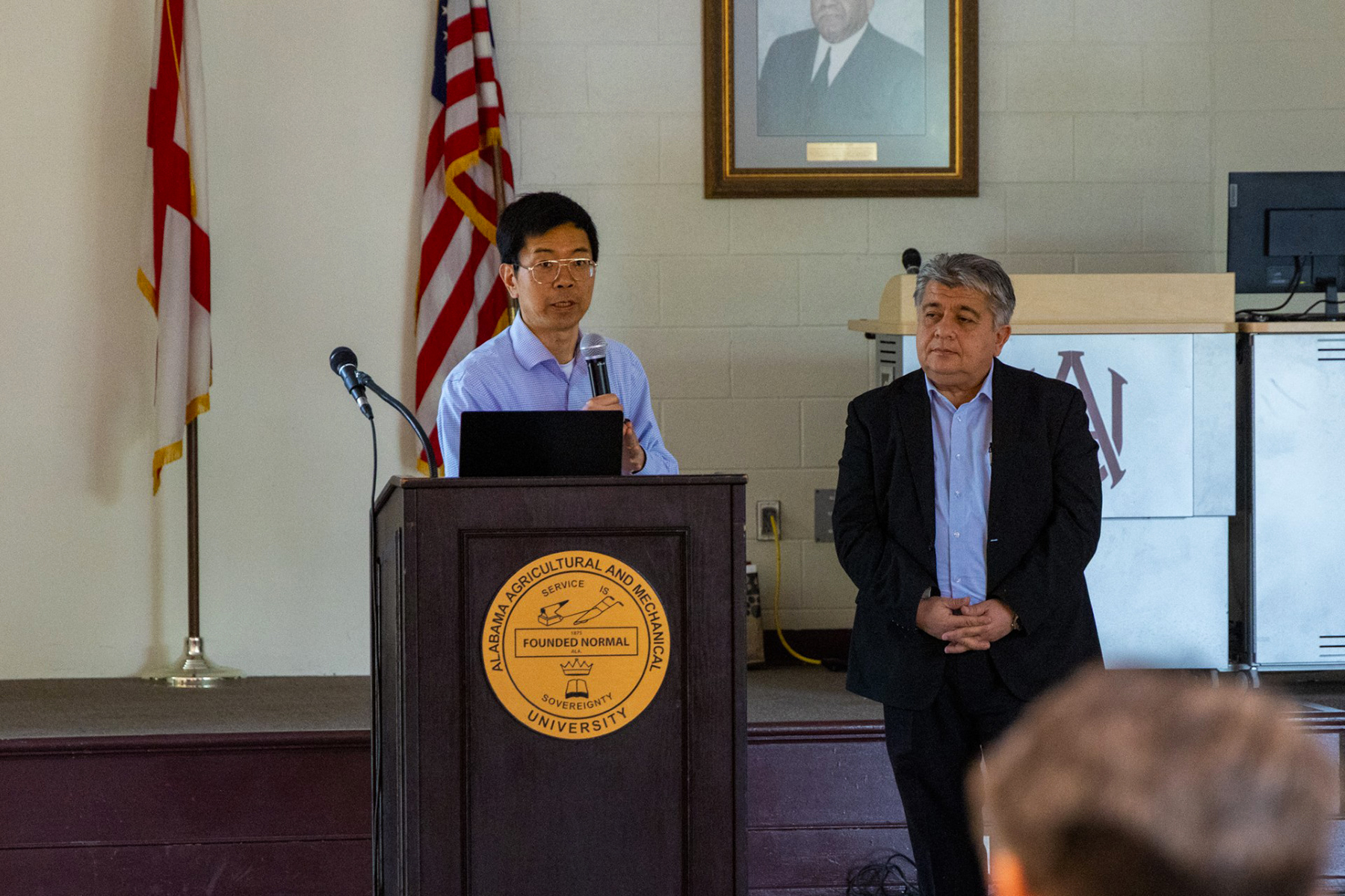
During a recent strategic briefing with U.S. Space Command, Dr. Satilmis Budak and Dr. Zhigang Xiao showcased Alabama A&M’s leadership in advanced microelectronics, presenting research in semiconductor materials, nanoelectronics, integrated circuit design and clean room-based chip fabrication. Their presentation highlighted the University’s growing role in developing next-generation technologies while preparing a highly skilled workforce for the rapidly evolving defense, aerospace and semiconductor industries.
Budak, professor of electrical engineering, interim chair of the Department of Electrical Engineering and Computer Science, and interim director of the Center of CHIPs, Microelectronics and Nanotechnology, has led numerous federally funded research initiatives focused on thermoelectric devices, semiconductor technologies, integrated circuits and emerging applications for defense and aerospace. Under his leadership, the center has expanded Alabama A&M’s capabilities in chip design, semiconductor fabrication and workforce development while strengthening collaborations with federal agencies, industry partners and academic institutions.
Xiao, professor of electrical engineering, associate director of the Center of CHIPs, Microelectronics and Nanotechnology and director of the RISE Center for Microelectronics and Materials, has played a key role in establishing and expanding the University’s state-of-the-art clean room fabrication facility. Supported by major instrumentation awards from the U.S. Department of Defense and the National Science Foundation, the facility provides hands-on research experiences for undergraduate and graduate students while supporting cutting-edge work in semiconductor fabrication, nanoscale electronic materials and very-large-scale integration circuit design.
During the briefing, Budak and Xiao demonstrated how Alabama A&M’s research spans the full spectrum of semiconductor innovation, from advanced materials and nanoelectronics to integrated circuit design and secure chip fabrication. Their work focuses on developing high-speed, low-power and secure electronic hardware designed to meet the demanding requirements of defense, aerospace and space exploration systems.
The researchers also emphasized the strategic importance of the University’s clean room facility in strengthening the nation’s microelectronics ecosystem. Beyond advancing semiconductor research, the facility provides experiential learning opportunities that prepare students for careers as engineers and researchers in industry, national laboratories and federal agencies. Their research aligns with national priorities to strengthen secure hardware, resilient semiconductor manufacturing and next-generation technologies that support the missions of the U.S. Department of Defense and U.S. Space Command.
The briefing featured presentations from several Alabama A&M research leaders, including Dr. Majed Dweik, vice president for Research and Economic Development; Dr. Z.T. Deng, dean of the College of Engineering, Technology and Physical Sciences; Dr. Timothy Mantz, executive director of the AAMU-RISE Foundation; and Dr. Paul Ruffin, chief scientist of the RISE Foundation.
Leading the discussion for U.S. Space Command was Richard Fierro, joint training manager supporting the Academic Engagement Enterprise, along with senior officials responsible for training, education and academic engagement initiatives.
The engagement comes at a pivotal time for Huntsville’s defense and aerospace community. With approximately 1,400 personnel expected to transition to Redstone Arsenal in the coming years, U.S. Space Command’s growing presence is creating new opportunities for collaboration among military, industry and higher education partners.
The briefing underscored Alabama A&M University’s commitment to advancing research that addresses complex scientific and engineering challenges while creating opportunities for collaboration with federal partners. As Huntsville continues to grow as a hub for defense, aerospace and semiconductor innovation, the University’s researchers are helping shape technologies that will strengthen the nation’s future space and security capabilities while preparing the next generation of engineers and scientists to lead in these critical fields.