Award Positions AAMU at Forefront of Advanced Nuclear Fuel Cycle Research and Student Workforce Development
AAMU Advances Nuclear Fuel Recycling Through U.S. DOE Partnership with Flibe Energy
Alabama A&M University is advancing research in nuclear fuel recycling through a new award from the U.S. Department of Energy Office of Nuclear Energy and a strategic partnership with Flibe Energy, Inc., a Huntsville-based nuclear energy company.
On Feb. 5, 2026, the DOE Office of Nuclear Energy announced more than $19 million in awards to five U.S. companies to develop technologies aimed at recycling used nuclear fuel. The three-year, cost-shared projects are designed to reduce nuclear waste by up to 90 percent and increase resource efficiency by as much as 95 percent, supporting national energy security goals. Flibe Energy was selected for contract negotiation under the program, with Alabama A&M serving as a key research partner. Funding amounts for individual partners have not been publicly released.
Under the Cross-Cutting Fluoride Pyrochemical Recycling of Used Nuclear Fuel project, AAMU faculty and students will focus on electrochemical decladding and fluorination technologies that support more efficient recycling of used nuclear fuel. The research will include developing, testing and validating advanced pyrochemical methods to improve process efficiency, strengthen safety protocols and enhance the economic viability of recycling efforts.
The project at AAMU is led by Dr. Mebougna Drabo, professor and chair of the Department of Mechanical and Civil Engineering and Construction Management, DOE Agency director of Alabama Established Program to Stimulate Competitive Research (ALEPSCoR), director of the Nuclear Engineering and Radiological Science Center, and interim graduate program coordinator for mechanical engineering.
“This award represents both an honor and a responsibility,” said Drabo. “It reflects confidence in our research capabilities and our commitment to excellence. We are building not only advanced nuclear technologies, but also the next generation of engineers and scientists who will shape the future of energy.”
Drabo is joined by Dr. Michael Ayokanmbi, Dr. Aschalew Kassu and Richard Lagle, who contribute expertise in nuclear engineering, materials science, instrumentation and experimental systems.
Flibe Energy, Inc., focuses on developing advanced molten-salt reactor technologies and innovative fuel cycle solutions, including electrochemical methods for processing and recycling used nuclear fuel. The early collaborations between AAMU and Flibe established a foundation that led to the expanded partnership under the DOE award.
“The molten salt laboratory partnership at Alabama A&M is exciting for the industry and for the future generation of engineers of every discipline,” said Dr. Joseph A. Bonometti, P.E., Chief Strategy Officer at Flibe Energy.
In fall 2025, AAMU and Flibe partnered to design and assemble a dedicated glovebox system to support molten salt and salt-handling experiments. The system enables controlled experimentation and provides students with hands-on experience in glovebox commissioning, system integration and operational validation.
Four STEM students in engineering and physical sciences programs are actively involved in the research. Two additional students are expected to join the project in summer 2026. Students are conducting molten salt experiments, analyzing electrochemical performance, evaluating process efficiency and contributing to safety and operational improvements.
University officials said the award strengthens AAMU’s research capacity in advanced nuclear science and expands hands-on learning opportunities. While the funding does not specifically allocate new equipment purchases, it supports expanded research activities, student engagement and collaborative experimental work using existing laboratory infrastructure and the newly developed glovebox system.
Drabo said the project represents a significant milestone for Alabama A&M University and the state.
“This milestone demonstrates the power of strategic partnerships between universities and industry to address complex national energy challenges,” he said. “Most importantly, it creates meaningful research and training pathways for our students, ensuring they are prepared to contribute to the next generation of nuclear energy technologies.”
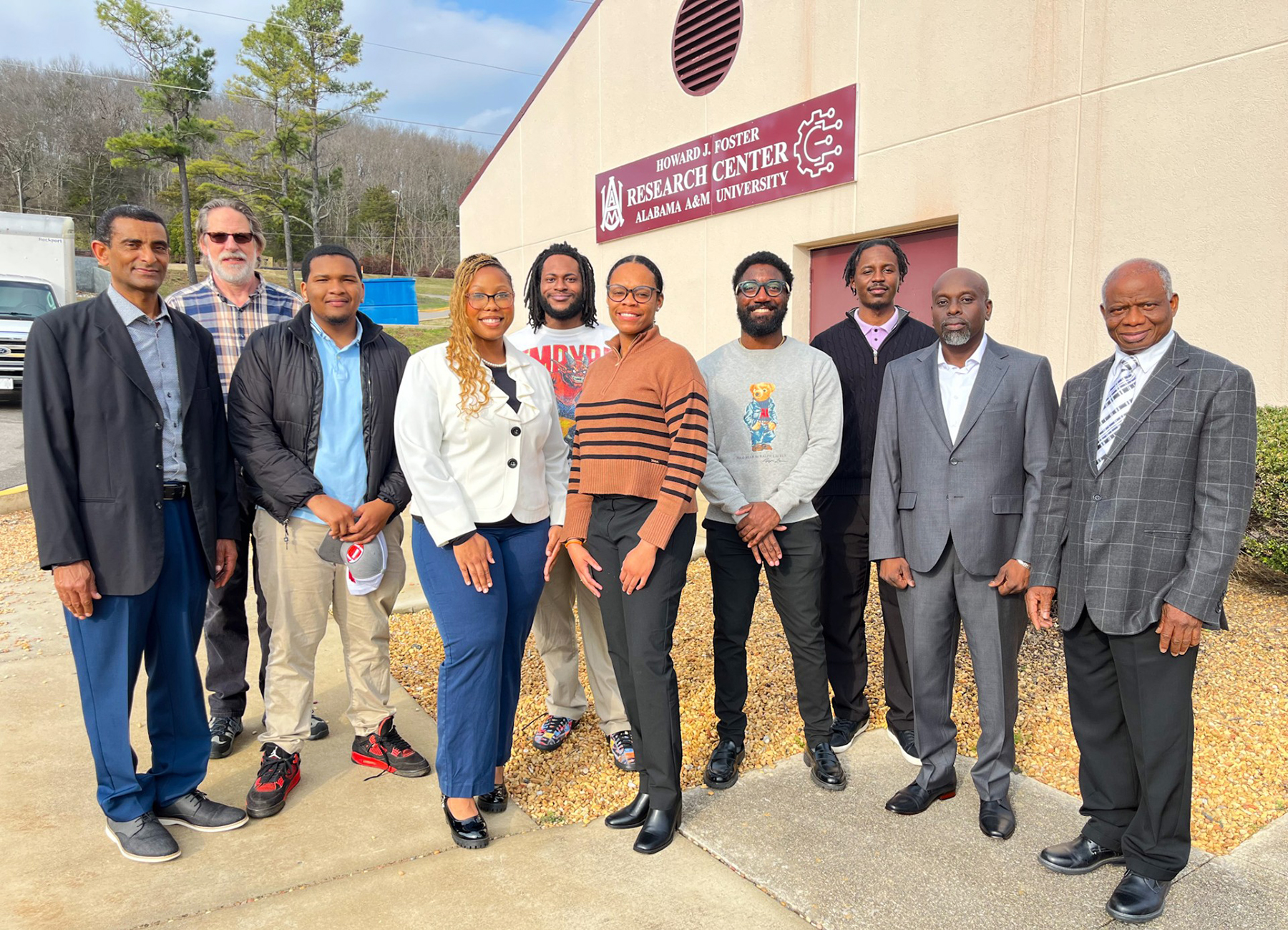
From left: Prof. Aschalew Kassu; Richard Lagle, mechanical engineering; Kermit Booker, graduate student, mechanical engineering; Shanel White, mechanical engineering student; Damari Bender, graduate student, mechanical engineering; Gabrielle Gray, electrical engineering senior; Jalil Rudolph, graduate student, mechanical engineering; Keith Rivers, graduate student, mechanical engineering; and Prof. Michael AyoKanmbi, systems engineering.