AAMU Professor Presents Innovations in AI, Machine Learning and Multispectral Imaging
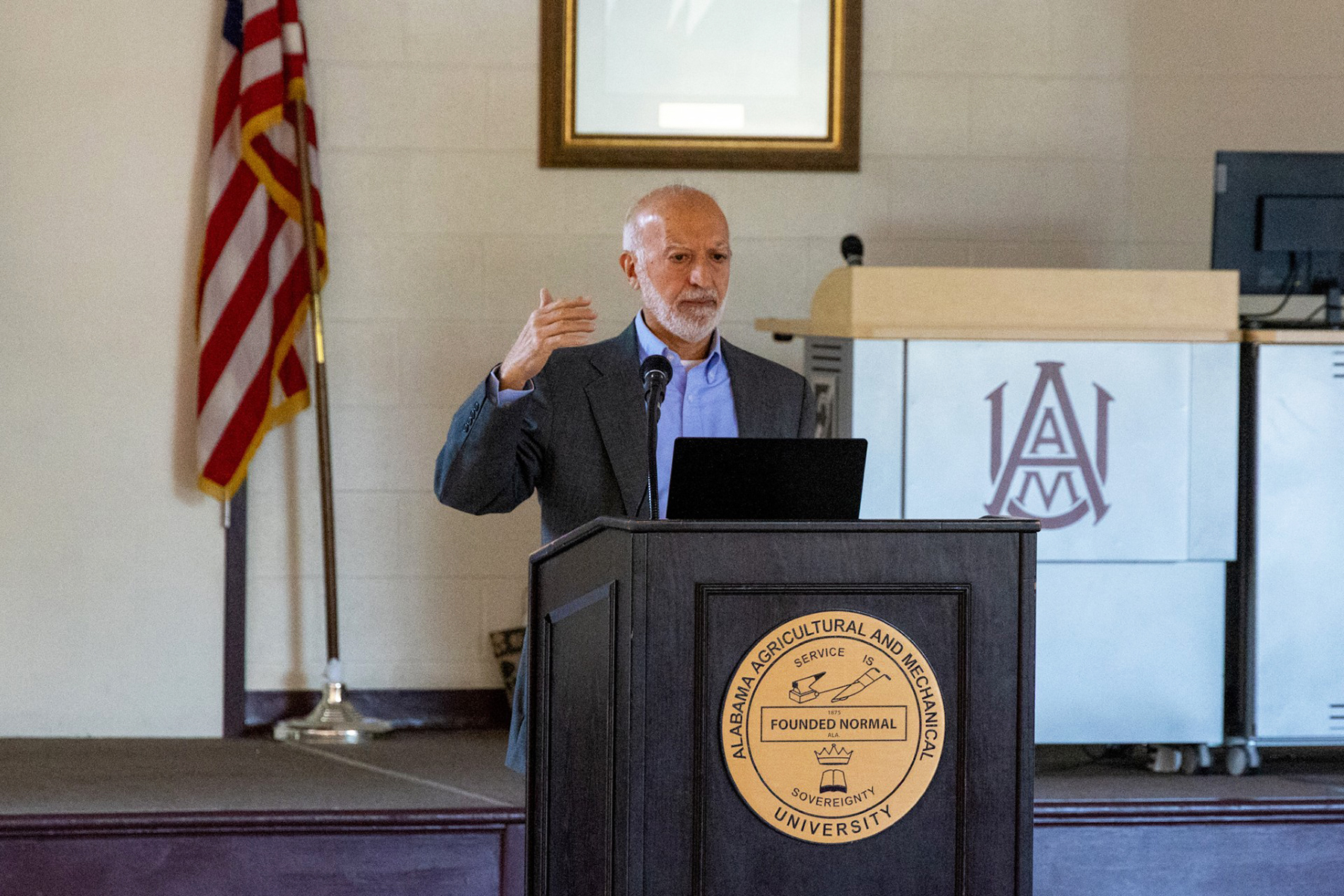
Heidary Showcases Advanced Research During U.S. Space Command Visit
Alabama A&M University faculty and leadership recently hosted officials from U.S. Space Command (SPACECOM) for a strategic research briefing that marked the command’s first formal engagement with AAMU researchers as SPACECOM establishes its permanent headquarters at Redstone Arsenal.
Among the featured researchers was Dr. Kaveh Heidary, professor of electrical engineering and director of the RISE Center for Sensors and Systems in the Department of Electrical Engineering and Computer Science. A faculty member at AAMU since 1998, Heidary presented research focused on artificial intelligence and machine learning applications for defense and space-related technologies.
Heidary earned his bachelor’s, master’s and doctoral degrees in electrical engineering from Syracuse University. Before joining Alabama A&M, he served as research faculty at Carnegie Mellon University and also taught at the University of South Carolina and West Virginia University.
Heidary’s presentation highlighted AI/ML applications for detection, classification and tracking of targets using infrared and multispectral imagery data, compression of hyperspectral imagery and video data, and development of AI/ML models for classification of audio signals using time-series and spectrogram analysis.
His broader research portfolio centers on advanced signal processing and intelligent systems, integrating AI and machine learning to address challenges in sensing, cybersecurity and security operations. His work includes applications in anomaly detection, hyperspectral imaging and remote sensing, sensor fusion, signal processing and applied electromagnetics.
Heidary said ongoing projects also include AI/ML applications for event classification using phase-sensitive optical reflectometry data in distributed acoustic systems, as well as development of autonomous transcription systems capable of classifying audio commands in complex operational environments.
“Research in advanced AI and ML integration is essential for the U.S. Space Force to maintain its operational edge in an increasingly contested domain,” Heidary noted. He explained that AI-enhanced infrared and multispectral imagery can improve detection and tracking of resident space objects and hypersonic glide vehicles, while advanced data compression can optimize transmission of critical tactical information from orbit in real time.
Heidary added that audio signal classification research has important applications in electronic warfare, enabling identification of novel waveforms and authentication of communication signals to strengthen cyber and electronic defense capabilities.
The SPACECOM delegation included Joint Training Manager Richard Fierro, Maj. Gen. Samuel C. Keener, Dan Mark and Michael Madsen. University presentations were led by Dr. Chance Glenn, Dr. Majed Dweik and Dr. ZT Deng, with additional participation from Dr. Timothy Mantz and Dr. Paul Ruffin.
Faculty presentations showcased a range of research areas supporting national defense and space innovation, including propulsion systems, radiation detection technologies, quantum optimization, secure decision-making systems, integrated circuit fabrication and advanced materials research.
SPACECOM officials also toured AAMU research facilities, including laboratories in the Howard J. Foster Research Center and the College of Engineering, Technology and Physical Sciences.
The engagement comes as U.S. Space Command expands its presence in Huntsville, with approximately 1,400 personnel expected to transition to Redstone Arsenal in the coming years.
Photo by Shannon Schmalfeldt