Expanding Research Initiatives Connect Artificial Intelligence, Agriculture and Engineering With Hands-On Student Learning
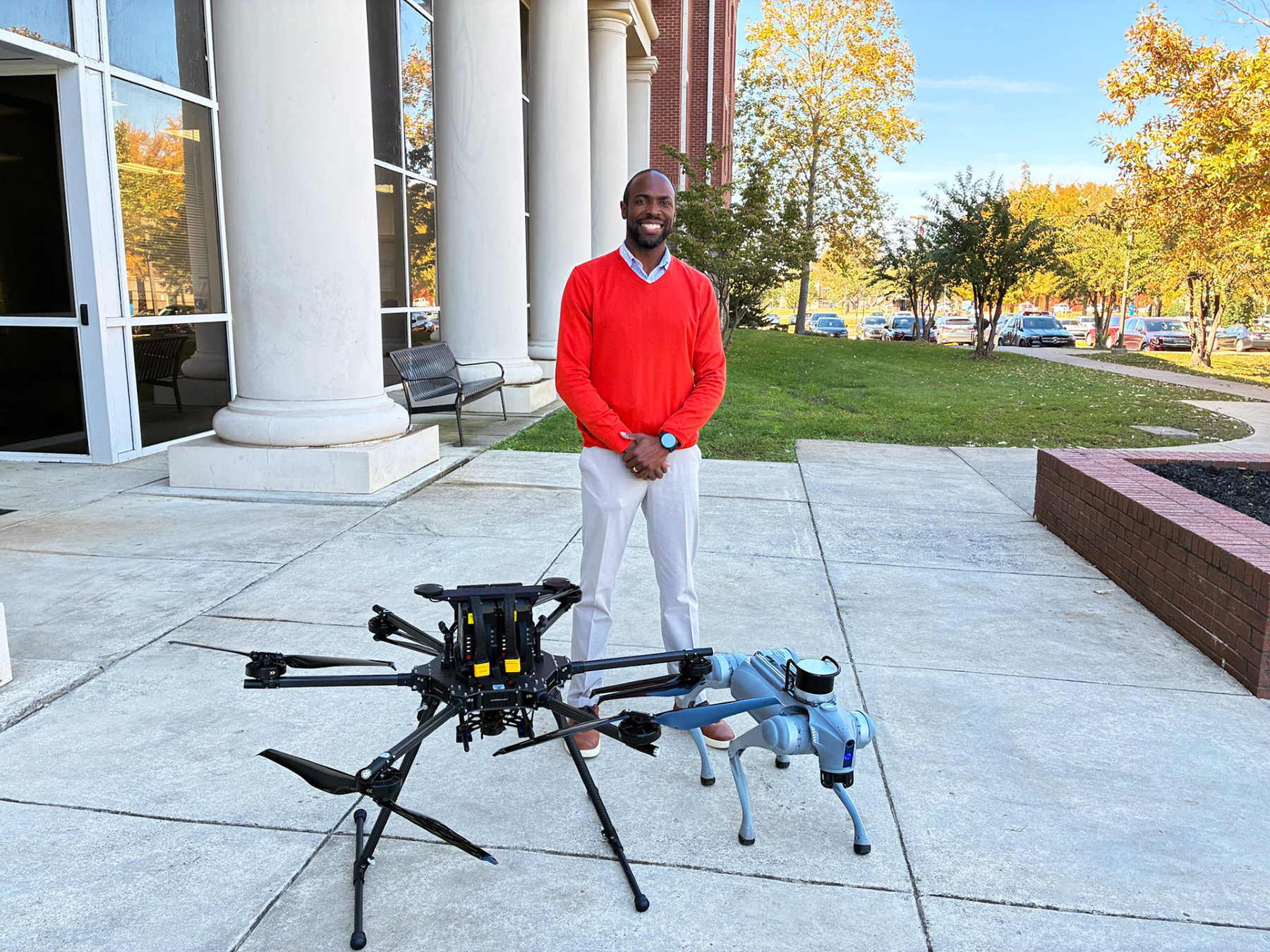
From Fields to the Future: Alabama A&M Advances AI Through Drones and Robotics
At Alabama A&M University, the future of artificial intelligence is taking shape on four legs and in the skies above campus.
A robotic dog named E-Butch, after the University’s Bulldog mascot, is part of an initiative combining artificial intelligence, robotics and drone technology to advance teaching and research. The effort could eventually help researchers monitor crops, survey unfamiliar terrain and collect environmental data without sending people into potentially hazardous areas.
Led by Alabama A&M alumnus and Unified Drone Unit Lead Justin Vaughner, the initiative is creating opportunities for students to explore how emerging technologies can address challenges in agriculture, engineering and environmental research.
The work coincides with a major academic milestone. In May 2026, Alabama A&M announced it was the first university in the state to offer a Bachelor of Science in Artificial Intelligence, positioning students for careers in one of the nation’s fastest-evolving technological fields.
Vaughner’s immediate focus is developing an AI-powered system that allows E-Butch to navigate and map environments autonomously while communicating with drones.
“My goal is to leverage AI to allow the system to navigate and map an area autonomously,” Vaughner said. “Using its onboard lidar sensor, it can accurately capture and model the environment without manual intervention.”
Lidar, or light detection and ranging, uses lasers to measure distances and create detailed maps of surrounding environments.
Vaughner envisions E-Butch exploring an unfamiliar area, detecting obstacles or hazards and transmitting information to a drone that could investigate further. For example, a forestry student could send the robotic dog into a cave to survey conditions before entering.
“The goal is to enable autonomous operation in areas where human presence is either unnecessary or poses potential risks,” Vaughner said.
Although autonomous communication between the robotic dog and drones remains a development goal, Vaughner sees applications extending well beyond surveying.
“You can use it for vegetation. You can use it in farming research,” he said.
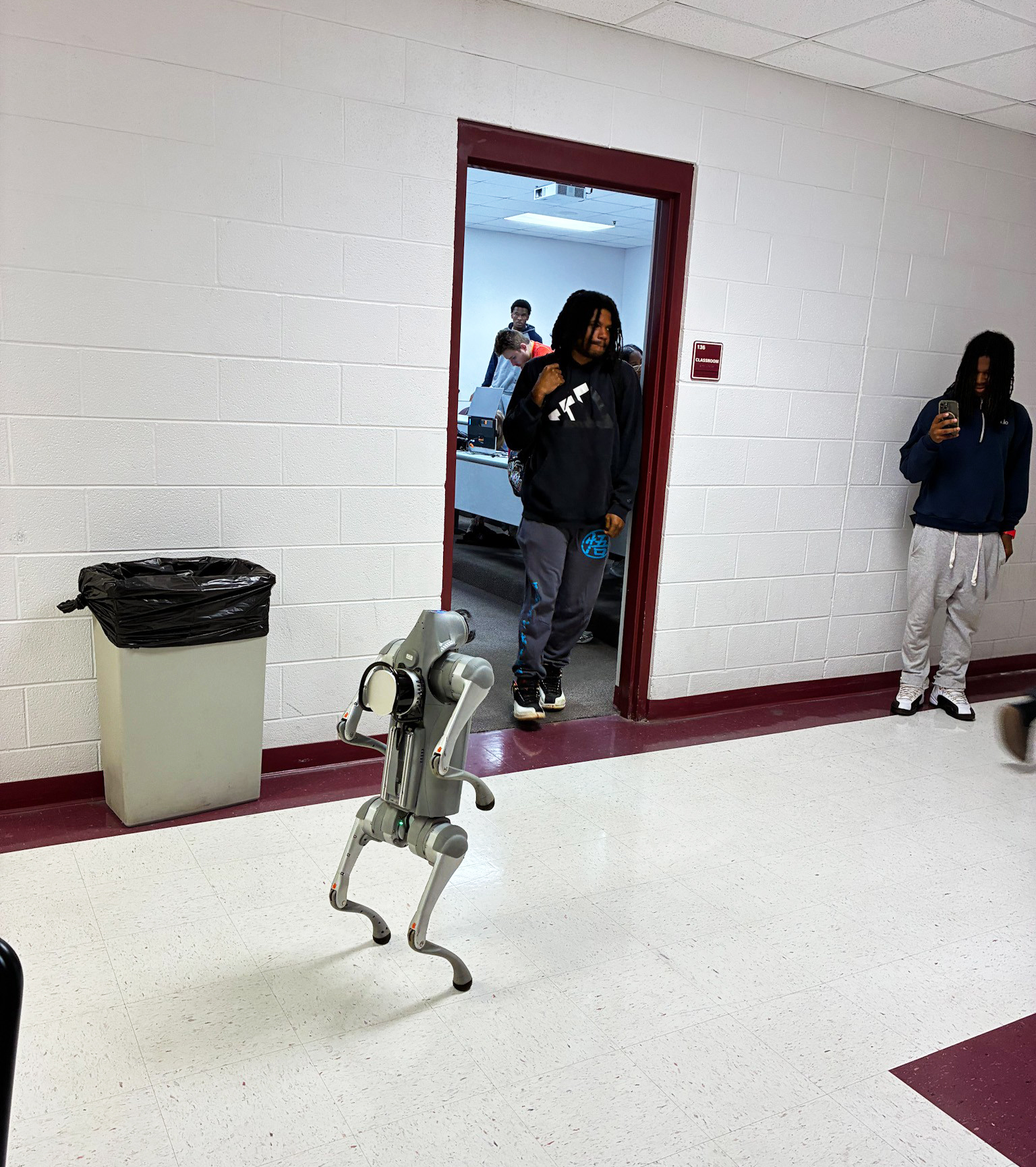
E-Butch, one of Alabama A&M University’s two robotic dogs, demonstrates its mobility as students observe on campus.
Agriculture is a particularly promising area for the technology. Alabama A&M researchers already use drones equipped with specialized cameras to monitor research plots, assess crop health and track plant growth. Multispectral imaging captures information beyond the visible spectrum, helping researchers identify changes in vegetation that might otherwise go undetected.
Vaughner hopes to expand those capabilities through hyperspectral imaging, which collects data across a wider range of wavelengths and could help researchers identify plant stress, disease and other conditions with greater precision.
Such applications could strengthen precision agriculture research, providing farmers and scientists with information to improve crop management, monitor environmental conditions and make more informed decisions.
Central to Vaughner’s vision is bringing together the University’s technological resources and research expertise.
“My priority is to bring people together, align our resources, and foster collaboration that maximizes our collective impact,” Vaughner said.
That approach could connect students and faculty in agriculture, computer science, engineering and geographic information systems, allowing them to collaborate on projects with practical applications.
For students, the initiative offers opportunities to move beyond classroom instruction and gain experience programming robotic systems, analyzing data and exploring AI applications. Computer science students could develop autonomous navigation systems, engineering students could work with sensors and robotics, and agriculture students could apply the technology to crop monitoring and environmental research.
“Most robotics or drone products come with software you can't look inside or control,” Vaughner said. “For education, that’s limiting. Here, students will get to decode, program, and actually see how these systems communicate and respond.”
Students are already involved in faculty-led research with the robotic dog, contributing to the University’s expanding work in robotics and artificial intelligence.
Zhengtao Deng, dean of Alabama A&M’s College of Engineering, Technology and Physical Sciences, said the initiative builds on years of investment in advanced research.
“We began collaborating with Sandia National Laboratories in 2019, building research platforms, and focusing on drone and robot communications,” Deng said. “When Justin came on board, he expanded those activities. Thanks to him, we are taking our program to the next level.”
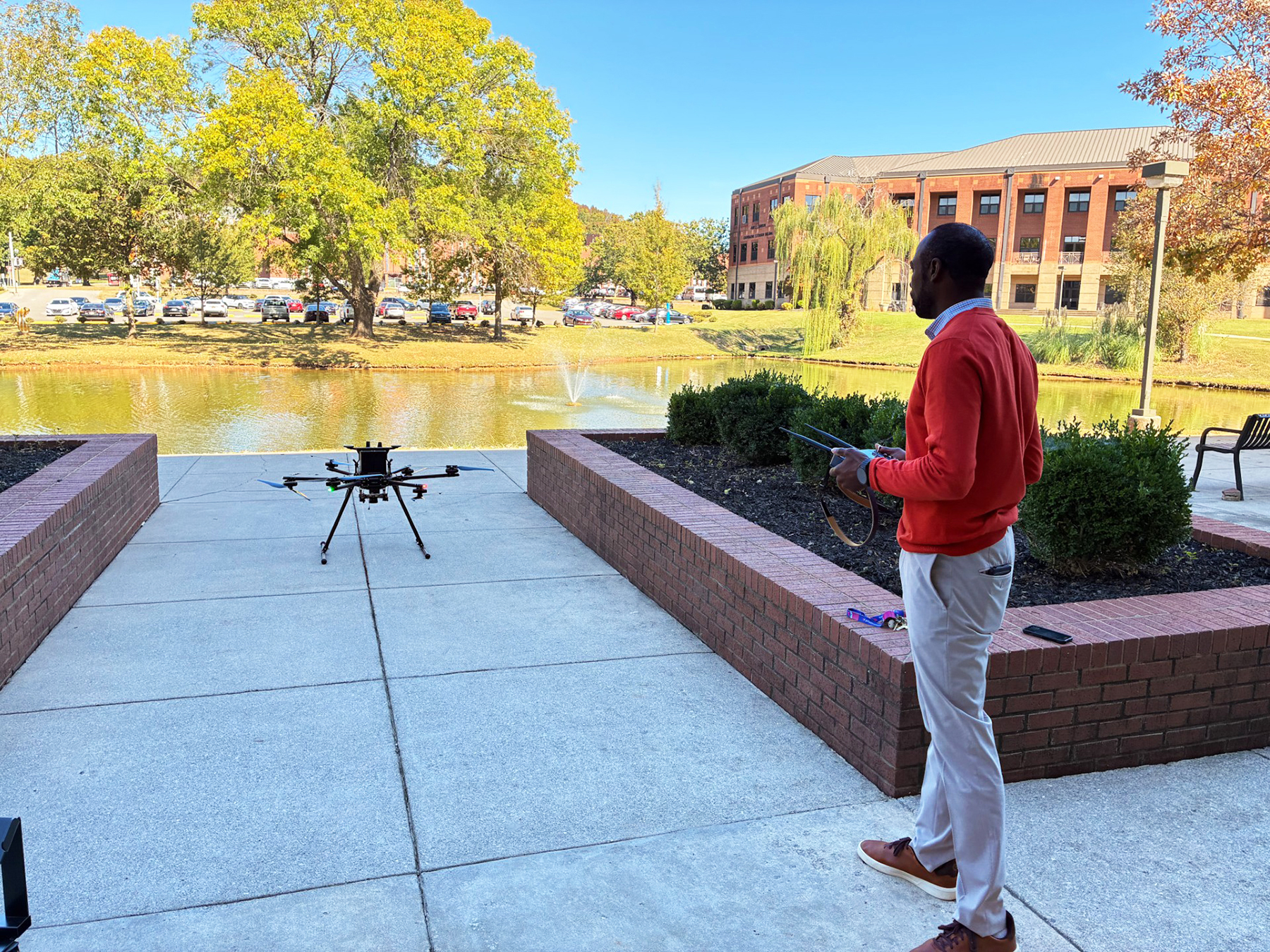
Justin Vaughner operates a research drone on the Alabama A&M University campus as part of the university’s expanding drone and robotics initiatives.
The program draws on approximately 25 drones of varying capabilities and two robotic dogs equipped with lidar sensors. Faculty involved in related research include Dr. Yujian Fu in computer science and Dr. Kaveh Heidary in electrical engineering. Research efforts have received support from the National Science Foundation and other funding sources.
“This is basically an education platform,” Deng said. “Students will not only understand programming, but also how AI works, how image processing works, and how different applications can come together. It is a strong collaboration that advances both teaching and research.”
Vaughner, who earned a bachelor’s degree in mechanical engineering in 2010 and a master’s degree in systems and materials engineering in 2023 from Alabama A&M, brings experience in engineering, information technology and agriculture to the initiative.
He also envisions partnerships with farmers, government agencies and industry organizations that could expand research capabilities, attract funding and create additional opportunities for students.
“We can showcase our technology and expertise to foster collaborative partnerships,” Vaughner said. “In doing so, we not only strengthen our ability to attract funding but also create opportunities for students to gain practical experience and contribute to impactful projects.”
For Alabama A&M, the initiative connects artificial intelligence with its land-grant mission, bringing technological innovation to agriculture, environmental research and workforce development.
And while E-Butch may turn heads with its ability to sit, wave and interact with visitors, its greater potential lies in what students and researchers can teach it to do.
“The Unified Drone Unit serves as a platform for experiential learning and innovation,” Vaughner said. “Beyond flight operations, it empowers students to develop sought-after skills that translate across a wide range of careers such as agriculture, engineering, and national defense.