Harvard Economist Explores How Mathematics Can Help Solve Society’s Most Complex Challenges
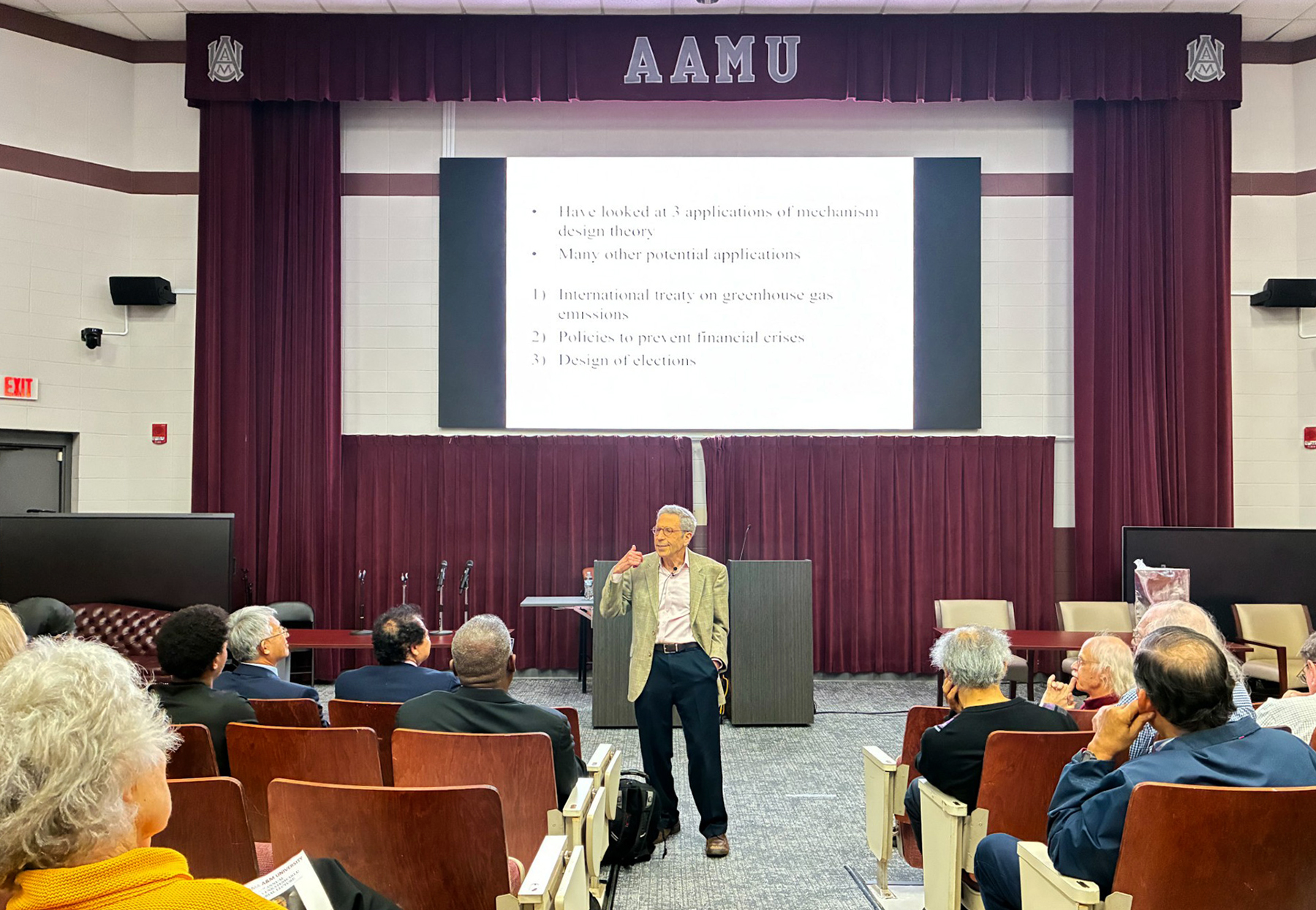
Nobel Laureate Eric Maskin Brings Economic Theory to Life at Alabama A&M
A simple question about dividing a cake became the starting point for a wide-ranging discussion of economics, mathematics and some of the world's most pressing challenges as Nobel Prize-winning economist Dr. Eric S. Maskin visited Alabama A&M University on Friday, Nov. 6.
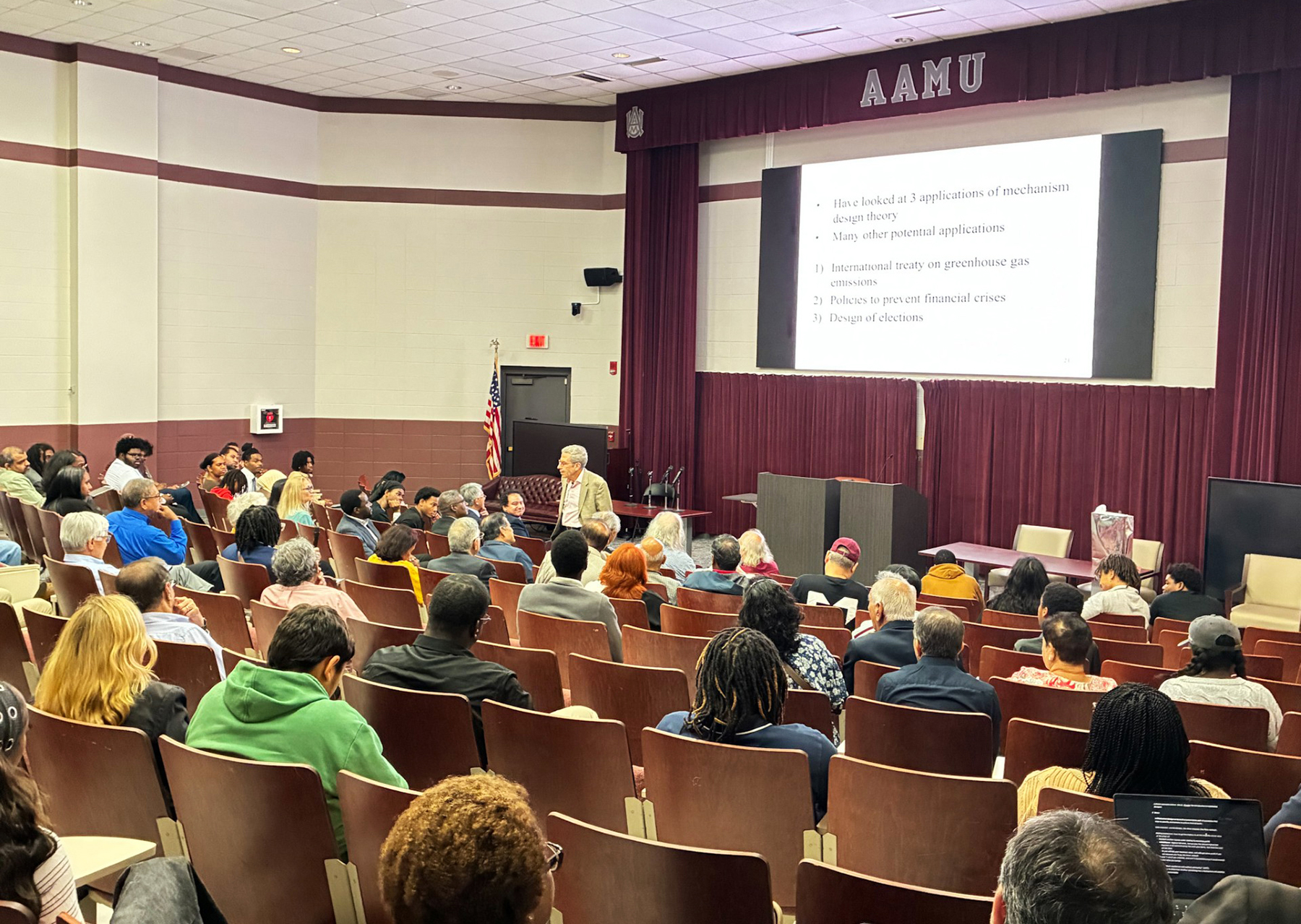
Maskin, a Harvard University professor and co-recipient of the 2007 Nobel Memorial Prize in Economic Sciences, delivered the 26th Annual Putcha Venkateswarlu Memorial Nobel Laureate Lecture in Dawson Auditorium. His presentation, “An Introduction to Mechanism Design,” introduced students, faculty and community members to a field of economic theory that uses mathematics to develop systems capable of producing desirable outcomes.
Throughout the lecture, Maskin demonstrated how seemingly simple mathematical principles can help address complicated questions involving fairness, resource allocation, public policy and human decision-making.
“I like to think of mechanism design as the engineering part of economics,” Maskin said.
He explained that while economists often study existing institutions and predict their outcomes, mechanism design approaches problems from the opposite direction. Researchers first identify a desired result, then work backward to determine what rules, procedures or institutions could make that result possible.
“We start by saying these are our goals. These are the outcomes we would like to achieve, and then we work backwards to ask whether we can design mechanisms, institutions, procedures, which will bring us toward those goals,” he said.
To make the concept accessible, Maskin began with an everyday dilemma: How can two children divide a cake so that each believes they have received a fair share?
His solution was straightforward. One child cuts the cake, while the other chooses the first piece. Because the child making the cut knows the other will choose first, there is an incentive to divide the cake as evenly as possible.
“It’s quite remarkable that without knowing how the children see the cake, you could nonetheless achieve a fair division, fair allocation,” Maskin said.
The example illustrated a central principle of mechanism design: Effective systems can encourage individuals pursuing their own interests to make decisions that also produce fair or beneficial outcomes.
Maskin then expanded the discussion to the allocation of radio frequencies, explaining how auction systems can be designed to encourage companies to reveal the true value they place on resources. He highlighted the second-price auction, in which the highest bidder wins but pays the amount of the second-highest bid, as an example of how carefully constructed rules can improve decision-making.
A third example explored how mathematical models could help policymakers select energy sources when consumers have competing preferences involving cost, convenience and long-term benefits.
Together, the examples demonstrated the practical significance of a field that has influenced modern economic theory and continues to shape approaches to public policy.
“Mechanism design goes back many decades, but interestingly, it remains a very lively field,” Maskin said. “And the reason it’s so lively is that new applications come along all the time.”
He pointed to emerging applications of mechanism design, including international agreements to reduce greenhouse gas emissions, financial regulations intended to prevent economic crises and improvements to election systems.
Maskin emphasized that developing effective solutions requires more than identifying a desirable outcome. It also requires understanding how individuals, organizations and governments respond to incentives.
The lecture offered attendees an opportunity to consider how mathematical research can extend beyond the classroom and influence decisions affecting communities and nations.
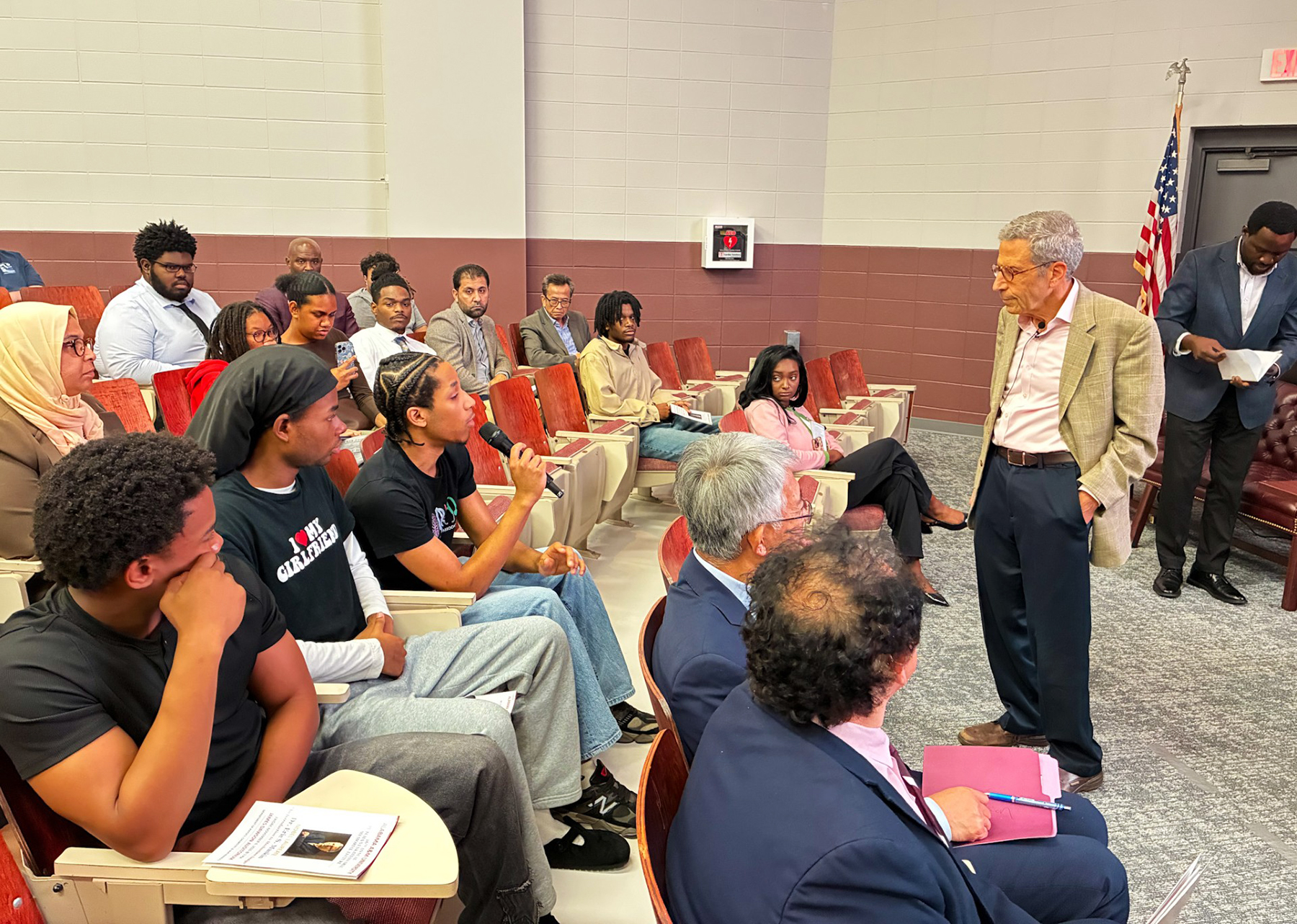
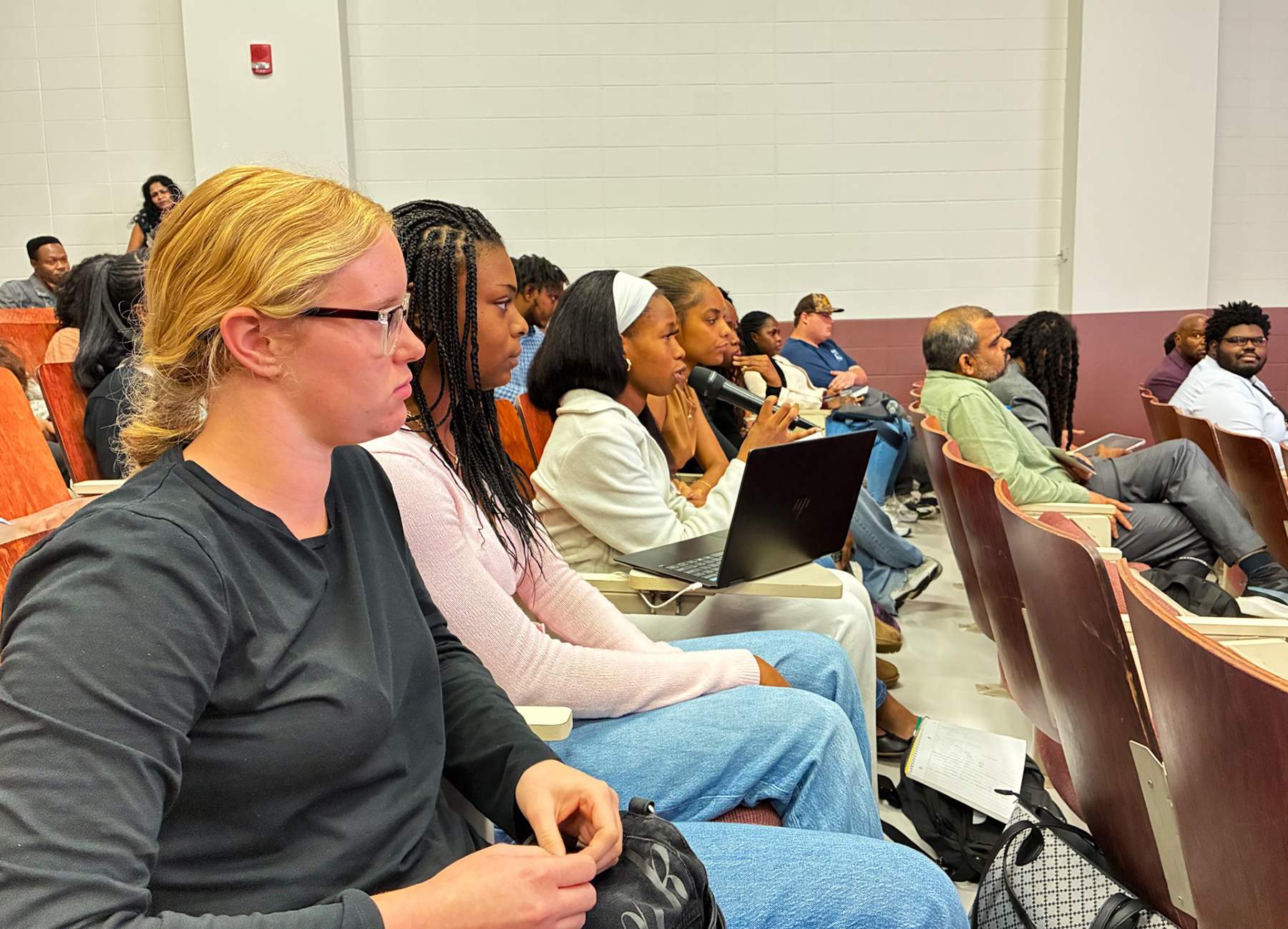
During a question-and-answer session, students engaged Maskin on contemporary economic issues, including how young people should approach investing in an uncertain economy.
In response to a student’s question, Maskin emphasized diversification as an important principle for managing investment risk.
“The key is diversification,” he said, explaining that spreading investments across different assets can help reduce exposure to individual losses.
The exchange reflected the broader purpose of the lecture series: connecting students with distinguished scholars whose research has shaped academic disciplines and contributed to society’s understanding of complex problems.
Now in its 26th year, the Putcha Venkateswarlu Memorial Nobel Laureate Lecture Series honors the legacy of Venkateswarlu, a longtime Alabama A&M physics professor whose dedication to scientific excellence, scholarship and intellectual discovery continues to inspire generations of students and researchers.
By bringing internationally recognized scholars to campus, the annual series provides opportunities for intellectual exchange while exposing students to groundbreaking research and new perspectives across disciplines.
Maskin’s visit continued that tradition, demonstrating how advanced mathematical ideas can be communicated through familiar experiences and applied to challenges extending far beyond the University.