Renowned Physicist Leaves a Legacy of Research, Leadership and Student Success
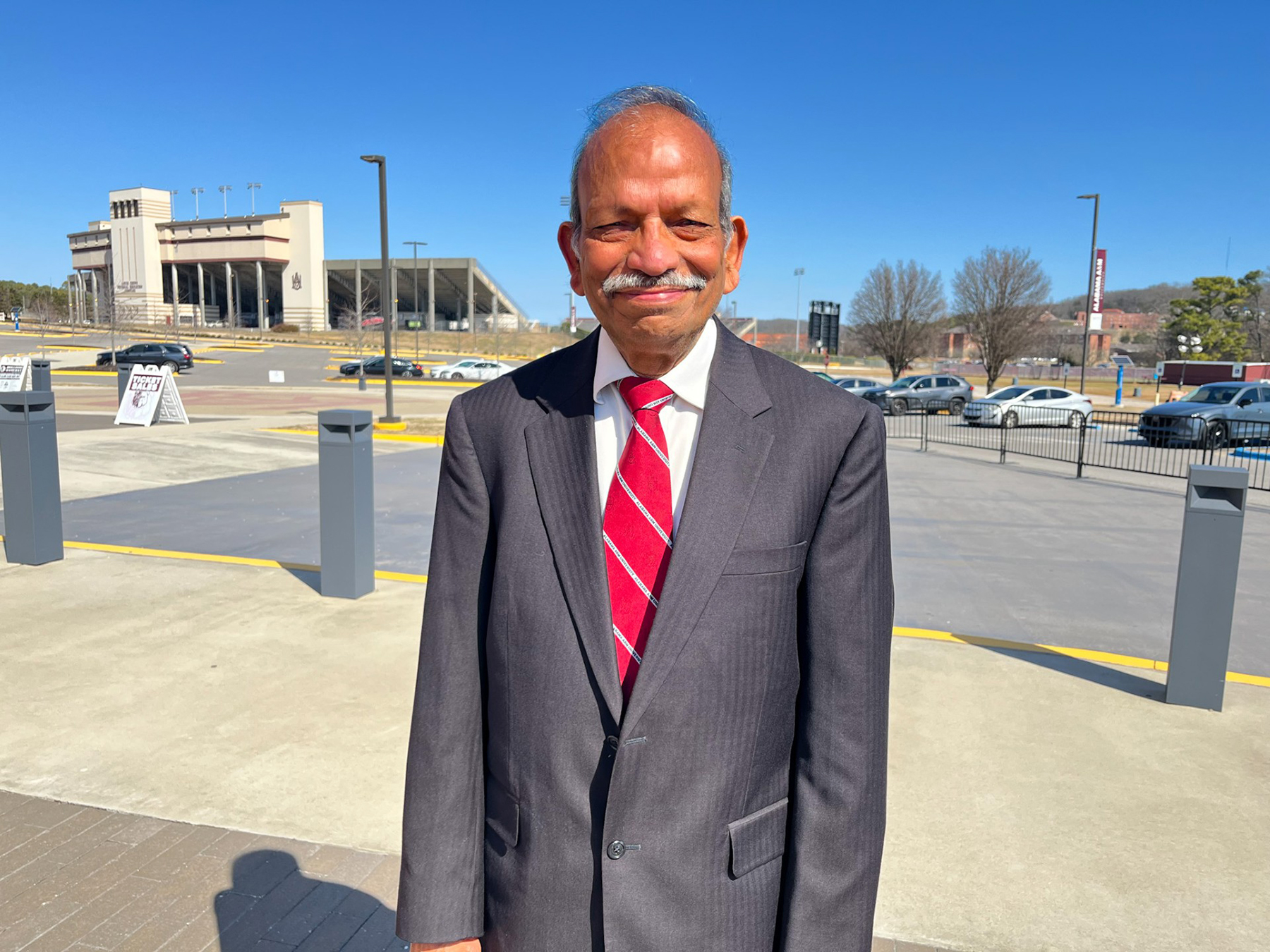
Dr. Mohan Aggarwal Retiring After 45 Years at AAMU
When Dr. Mohan Aggarwal arrived at Alabama A&M University in 1981, he came to Huntsville to conduct research connected to a NASA spaceflight experiment. He could not have known then that the opportunity would become the beginning of a 45-year career that would help transform physics education and research at AAMU and influence generations of students and scientists.
Aggarwal, a renowned physicist, prolific researcher, longtime professor and former department chair, will retire Aug. 31 after more than four decades of service to the University.
His journey to Alabama A&M began thousands of miles away in Ambala Cantonment, a military town in northern India. After earning a bachelor’s degree with honors in mathematics from Panjab University in 1966 and a master’s degree in physics from the University of Roorkee in 1968, Aggarwal completed post-master’s work at the Saha Institute of Nuclear Physics. He earned his Ph.D. in physics from the University of Calcutta in 1974.
In 1980, Aggarwal came to the United States as a postdoctoral scholar at Pennsylvania State University, where his research focused on developing solar cells using polysilicon.
A year later, another scientific opportunity brought him south.
“I came to Huntsville in 1981 from Pennsylvania State University to do research on the NASA Spacelab-3 experiment to grow infrared crystals in zero gravity,” Aggarwal said.
At AAMU, Aggarwal worked with Professor Ravi Lal and astronauts on crystal-growth experiments aboard Spacelab-3 and later contributed to the International Microgravity Laboratory-1 mission, which grew crystals in space in 1992.
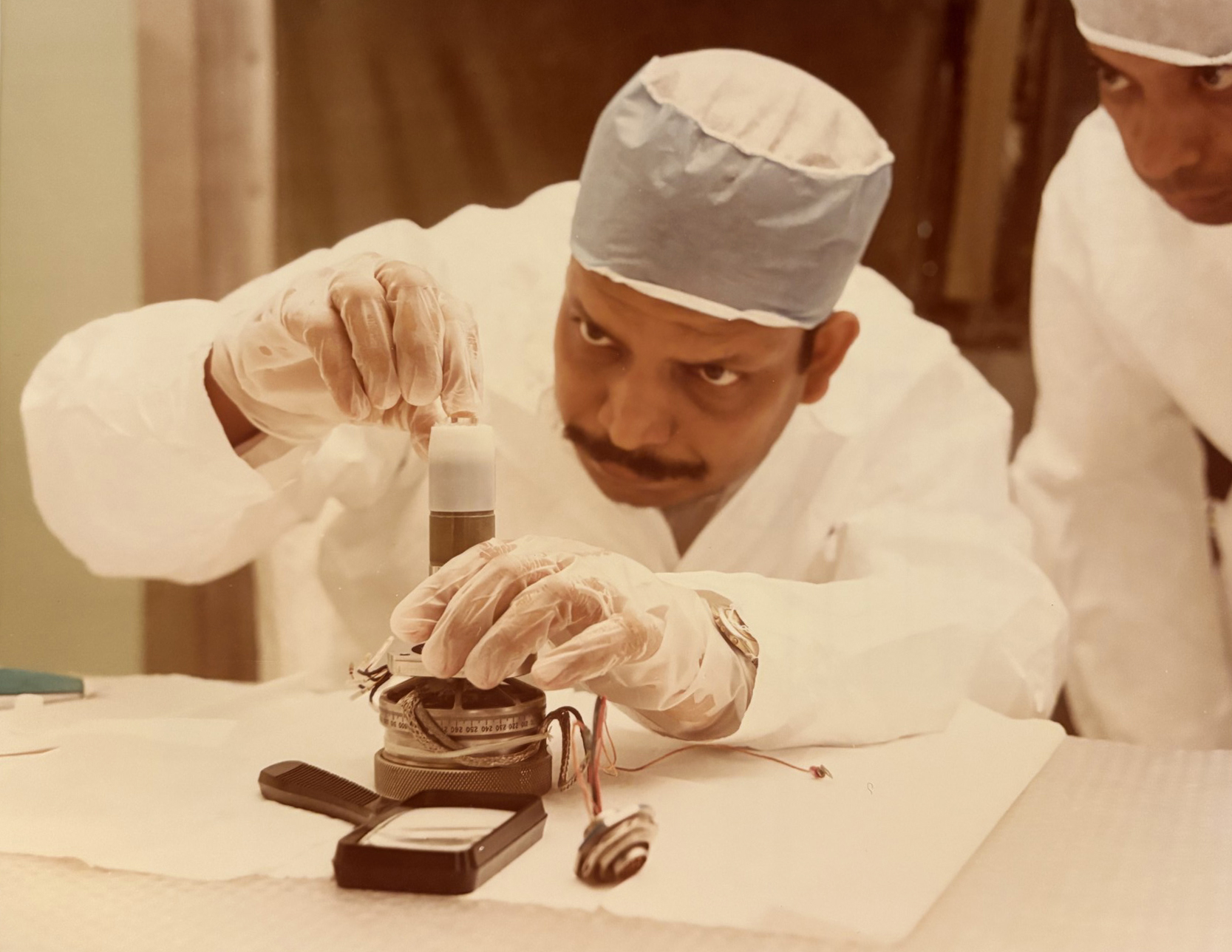
Dr. Mohan Aggarwal conducts research in an Alabama A&M University laboratory. The photo is undated.
He joined AAMU in 1981 as a postdoctoral research associate and was appointed assistant professor of physics in 1983. He was promoted to associate professor in 1986 and full professor in 1993.
But Aggarwal’s impact would extend far beyond his own laboratory.
Soon after arriving, he began teaching graduate courses in AAMU’s master’s program in physics and working to establish something the University had never had before: a doctoral program in physics.
“I taught graduate courses for the master’s program in physics that initiated in 1981,” Aggarwal said. “I also worked in proposal writing to bring the doctoral program in physics, and we were successful in getting our first Ph.D. program approved in 1986.”
AAMU became one of the earliest historically Black colleges and universities in the nation to establish a Ph.D. program in physics. In 2025, the program celebrated another historic achievement when its 100th doctoral graduate walked across the commencement stage.
Among the program’s graduates is Dr. Shelia Nash-Stevenson, the first African American woman in Alabama to earn a Ph.D. in physics, who went on to a career at NASA’s Marshall Space Flight Center.
For Aggarwal, those students and their accomplishments are among the most meaningful measures of his career.
“All our Ph.D. graduates are gainfully employed,” he said. “At present, I am teaching undergraduate courses that help us recruit and attract more students into the physics major.”
Aggarwal also spent nearly two decades guiding the department from an administrative role. He served as chair of the physics department from 2001 to 2011 and chair of the Department of Physics, Chemistry and Mathematics from 2011 to 2019, overseeing growth in enrollment, research productivity and doctoral education.
His scholarly record is equally extensive.
During his career, Aggarwal secured approximately $12 million from federal agencies, including the National Science Foundation, NASA and the U.S. Army Space and Missile Defense Command. He led or co-led more than 20 research proposals and contracts and helped develop sophisticated crystal-growth research facilities at AAMU.
His research has encompassed the crystal growth of nonlinear optical materials, microgravity research, solid-state devices, ion implantation, infrared materials, piezoelectric materials and structural health monitoring.
Aggarwal has authored approximately 275 peer-reviewed publications, four books, two patents and five NASA technical memoranda. He has served as major adviser to eight doctoral students while mentoring numerous master’s students.
One of his signature initiatives was the $8 million NSF-funded Alliance for Physics Excellence, or APEX, which operated from 2012 to 2018 and trained approximately 78 high school physics teachers across Alabama. He also serves as co-investigator on a $1.43 million NSF Noyce project focused on preparing STEM graduates for effective teaching and improving student learning in science and mathematics.
His contributions have earned recognition from his peers as well.
Aggarwal was elevated to Fellow of the Alabama Academy of Science, one of the state’s highest recognitions for scientific achievement and service. The lifetime designation recognizes members who have made outstanding contributions to science and demonstrated meritorious service to the organization.
Yet for all the grants, publications, experiments and accolades accumulated over 45 years, Aggarwal has consistently described teaching as central to his work.
“I enjoy brainstorming new ways to teach a physics topic so that our students are not only prepared but motivated to advance in STEM careers,” he said.
As retirement approaches, Aggarwal said he will miss the exchange of ideas that has defined much of his career — in the laboratory, the classroom and among colleagues.
“Going in the laboratory and brainstorming about new ideas with other researchers and students,” Aggarwal said when asked what he would miss most about research.
He said he will also miss the relationships built over more than four decades on The Hill, where colleagues became friends and students became fellow scientists.
“I have learned a lot from discussing various research topics and learned life wisdom, and I shall miss those times,” Aggarwal said, adding that he learned valuable lessons from colleagues throughout the department.
Leaving his students will be bittersweet, but Aggarwal said he takes satisfaction in knowing that he helped prepare generations for what came next.
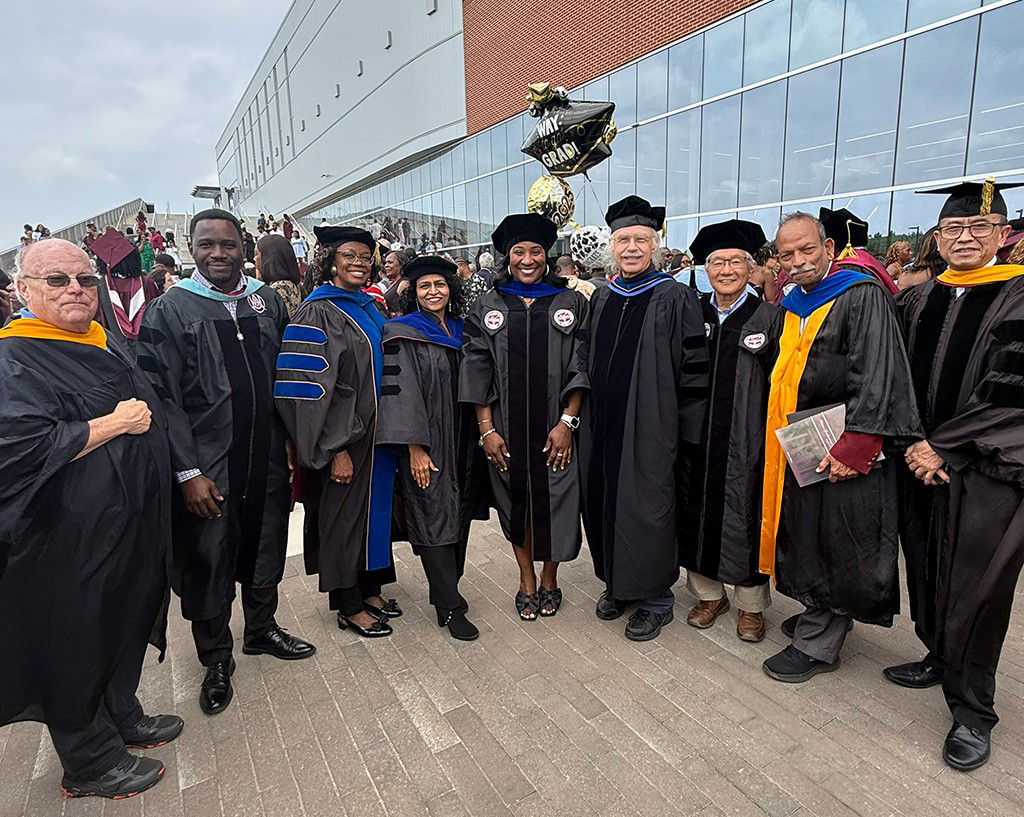
Dr. Mohan Aggarwal, second from right, joins Alabama A&M University physics faculty in celebrating Dr. Angela Davis, center, the program’s 100th Ph.D. graduate, following commencement in 2025.
“I shall miss students, but it is gratifying to feel that I did my duties effectively and trained lots of students and have heard lots of kind words and positive comments,” he said.
Retirement, however, will not mean saying goodbye to Alabama A&M.
Aggarwal plans to return to campus for events, including commencement and the Black Tie Gala, and expects to continue helping graduate students pursuing doctoral degrees in physics.
He is also looking forward to something that a demanding academic career did not always leave much time for: traveling with his wife, Saroj.
Aggarwal came to Huntsville with Saroj in 1981. Their family now includes their son, Manish; daughter-in-law, Parina; and grandson, Keshav.
“My wife’s reaction was very positive,” he said of his retirement decision. “According to her, I devoted all my time to work — teaching and research — and now we look forward to traveling together.”
Switzerland and Vienna are among the destinations Aggarwal hopes to visit with family and friends.
The decision to retire came as he reflected on the strength of the physics program he helped nurture. After 45 years, Aggarwal said the department is thriving, has established a reputation among HBCUs and has reached milestones that once existed only as aspirations.
He leaves behind laboratories he helped build, millions of dollars in funded scientific research, a doctoral program he helped establish and generations of students who carried their AAMU education into careers of their own.
But Aggarwal also leaves with something Alabama A&M gave him.
“Working at A&M has made an enormous impact on me,” he said. “The ‘Service Is Sovereignty’ motto is one I believe to my core.”
That commitment to service runs through Aggarwal’s 45-year career — from teaching and research to leadership and mentorship. As he prepares to leave his daily place on The Hill, his final reflection is not about an award, publication or scientific discovery, but gratitude.
“I shall always treasure my days of service at Alabama A&M University and shall remain highly grateful for the opportunity given to me to serve at the University.”