Research Presented to U.S. Space Command Addresses Emerging Challenges in Space Operations
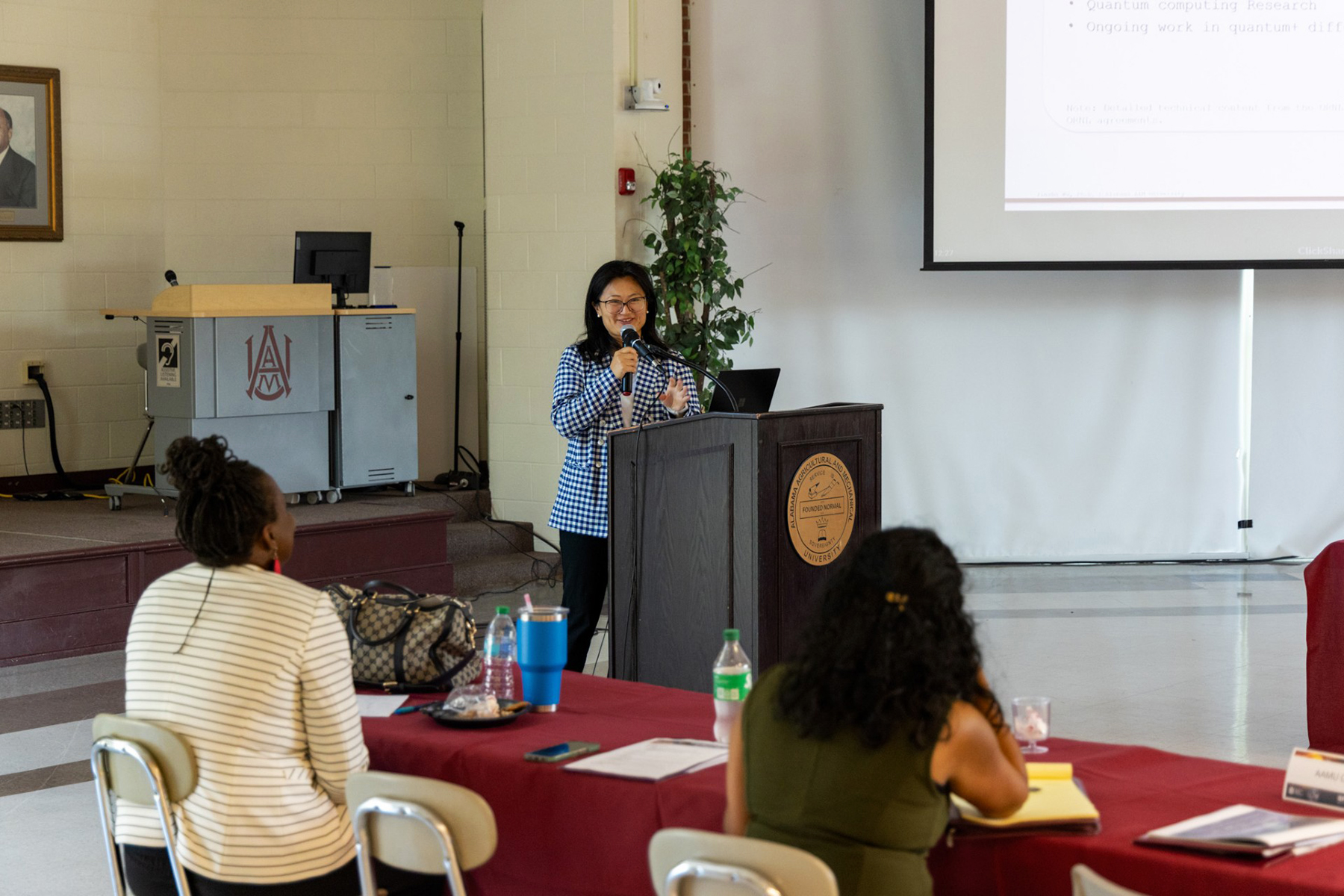
Wu Explores Quantum Computing Solutions for Orbital Maneuver Planning
Alabama A&M University Associate Professor of Mathematics Dr. Yinshu Wu is exploring how mathematics and emerging quantum computing technologies could help address some of the complex decisions involved in moving and managing spacecraft in orbit.
Wu presented her research, “Quantum Optimization Algorithms for ODE-Based Orbital Maneuver Planning,” during a strategic engagement between Alabama A&M researchers and U.S. Space Command officials. The meeting highlighted AAMU research capabilities and academic expertise with potential applications to national defense, space operations and workforce development.
Wu’s research examines how applied mathematics, differential equations, optimization and quantum computing can be brought together to address orbital maneuver planning. Her approach uses ordinary differential equation, or ODE, systems to model orbital dynamics and then frames maneuver planning as a constrained optimization problem.
From there, emerging quantum optimization techniques, including hybrid quantum-classical approaches and the Quantum Approximate Optimization Algorithm, or QAOA, can be explored as complementary computational tools for solving complex decision-making problems.
The potential applications extend to some of the challenges facing an increasingly active and complex space environment. Orbital maneuver planning can play a role in collision avoidance, orbital transfers, coordination among multiple satellites, space traffic management and maneuvering spacecraft while operating under numerous constraints.
“These are high-dimensional optimization problems with operational importance,” Wu said. “Exploring new computational frameworks may support future research collaboration.”
Wu’s work also demonstrates the interdisciplinary nature of emerging space research at Alabama A&M, connecting mathematics with computer science, artificial intelligence, quantum computing and aerospace applications.
“This research direction is important to AAMU because it connects mathematics, computer science, artificial intelligence, quantum computing and aerospace applications,” Wu said. “It also supports AAMU’s growing research strengths in emerging technologies and provides opportunities to engage students in interdisciplinary research related to space, defense and advanced computation.”
Wu, who serves as Mathematics Program coordinator in AAMU’s Department of Physics, Chemistry and Mathematics, has been a member of the University faculty for 15 years. She earned her doctorate in applied mathematics, with a minor in computer science, from the University of Alabama in Huntsville in 2011.
Her areas of expertise include applied mathematical modeling, differential equations, machine learning, artificial intelligence, quantum computing and optimization. Last summer, Wu participated in the Oak Ridge National Laboratory Visiting Faculty Program, where her research focused on using quantum computing to simulate partial differential equations.
Her current work builds on that experience by continuing to investigate connections between quantum computing and differential equations. Future research directions include ODE-based orbital maneuver planning as well as opportunities for AAMU students to participate in mathematical modeling, benchmarking and computational experiments.
Wu was among several Alabama A&M faculty members who presented research during the University’s first formal engagement with U.S. Space Command as the command prepares to establish its permanent headquarters at Redstone Arsenal.
Faculty presentations highlighted research in artificial intelligence applications for target detection and tracking, propulsion systems for space applications, radiation detection technologies, quantum optimization for orbital maneuver planning, secure decision-making systems, integrated circuit fabrication, advanced materials and energy systems.
SPACECOM officials also toured AAMU research facilities, including laboratories within the Howard J. Foster Research and Innovation Center and the College of Engineering, Technology and Physical Sciences. The visit provided an opportunity for command leaders to learn more about AAMU’s research infrastructure, academic programs and potential to help prepare students for careers in the expanding space and defense sectors.
With U.S. Space Command establishing a growing presence at Redstone Arsenal, the engagement creates opportunities for AAMU researchers to connect their expertise to emerging challenges in space operations while opening potential pathways for collaborative research and student development.