AAMU Students Gain Experience Studying Bacteria with Implications for Ecology and Human Health
Alabama A&M University Selected for National HHMI SEA-PHAGES Research Program
Alabama A&M University has been selected to join the Science Education Alliance–Phage Hunters Advancing Genomics and Evolutionary Science (SEA-PHAGES) program, an internationally recognized undergraduate research initiative led by the University of Pittsburgh and the Howard Hughes Medical Institute’s (HHMI) Science Education Alliance.
Founded in 2008, the Science Education Alliance supports faculty at two-year and four-year colleges and universities in implementing course-based undergraduate research experiences. These hands-on courses are designed to improve student learning, increase retention in STEM fields, and provide early access to authentic scientific discovery. Faculty from more than 150 institutions guide more than 5,500 undergraduate students through SEA research projects each year.
Through SEA-PHAGES, students study bacteriophages—viruses that infect bacteria—which are among the most abundant and genetically diverse biological entities on Earth. Research in this area has broad implications for ecology, biotechnology, and human health.
SEA-PHAGES is a two-semester, discovery-based research course that begins with students collecting soil samples to identify new viruses. The curriculum advances through microbiology techniques, genome sequencing and bioinformatics analysis. Students discover and name their own bacteriophages, gaining a strong sense of ownership while contributing to a nationally coordinated scientific effort.
“Joining the HHMI SEA-PHAGES program represents a transformative step for Alabama A&M,” said Dr. Laricca London, chair of the Department of Biological and Environmental Sciences. “This initiative, led by Dr. Dana Indihar, assistant professor of microbiology/virology, and myself, will immerse our students in authentic research early in their academic careers, fostering both scientific curiosity and technical skill.”
Alabama A&M was accepted into the program as part of Cohort 18 in early 2025 and began offering the SEA-PHAGES curriculum in Fall 2025 through Research in Biology (BIO 481) and Allied Health Microbiology (BIO 220). Biology majors with a GPA of 3.5 or higher are personally invited by Drs. Indihar and London at the start of each fall semester. Program spaces are limited, with a select number of seats reserved for incoming freshmen who apply directly.
“This selection places Alabama A&M among a select group of institutions nationwide that offer undergraduates early, meaningful research experiences in microbiology and genomics,” said London. “This partnership reflects AAMU’s land-grant mission to advance knowledge through research and provide transformative educational experiences, and it underscores our commitment to experiential learning and student success.”
Through the program, students isolate bacteriophages from soil samples, analyze genetic material, travel to the University of Alabama at Birmingham for imaging, and use bioinformatics tools to annotate viral genomes. Student discoveries are submitted to the national GenBank database and published in peer-reviewed scientific journals, allowing undergraduates to contribute to the global scientific community. Students will present their research at the Annual SEA-PHAGES Symposium, scheduled for April 24-26 this year.
“This program changes lives and sets students on the path towards success,” added Indihar. “I participated in this program myself as an undergraduate and was inspired to pursue a career in virology-based research because of it. It is my hope that the students who participate in this program are equally as inspired by it to pursue STEM careers.”
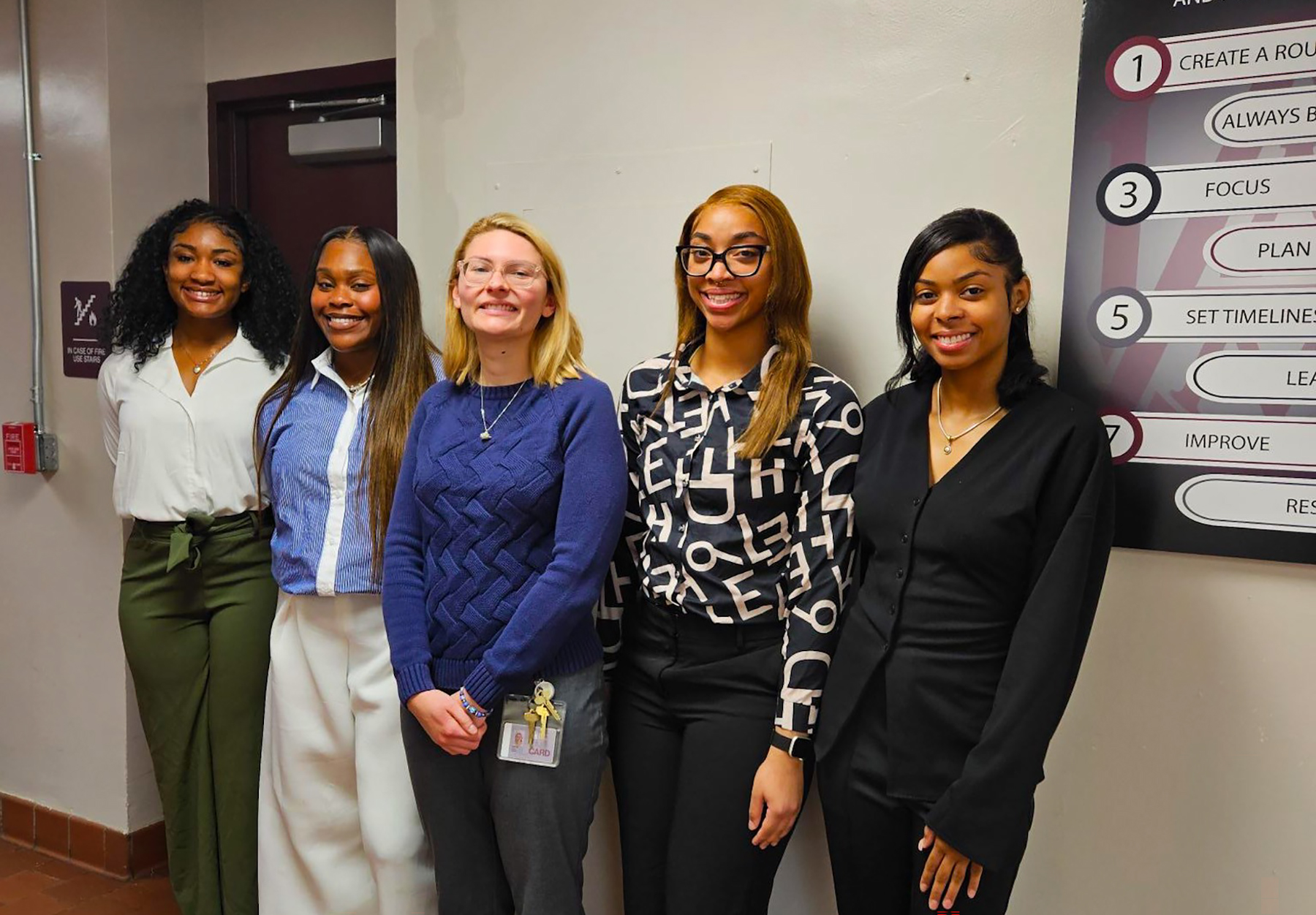
AAMU students enrolled in the SEA-PHAGES program include (pictured, from left) Junia Williams, a biology sophomore from Westland, Michigan; Kayci Miles, a biology sophomore from Conyers, Georgia; Dr. Dana Indihar; Jade Ray, a biology sophomore from Montgomery, Alabama; and Mya Hayes, a biology junior from Detroit. Not pictured: Skylar Posey, a biology freshman from Detroit