Dr. Congxiao Liu Collaborates with Longtime Colleague in China
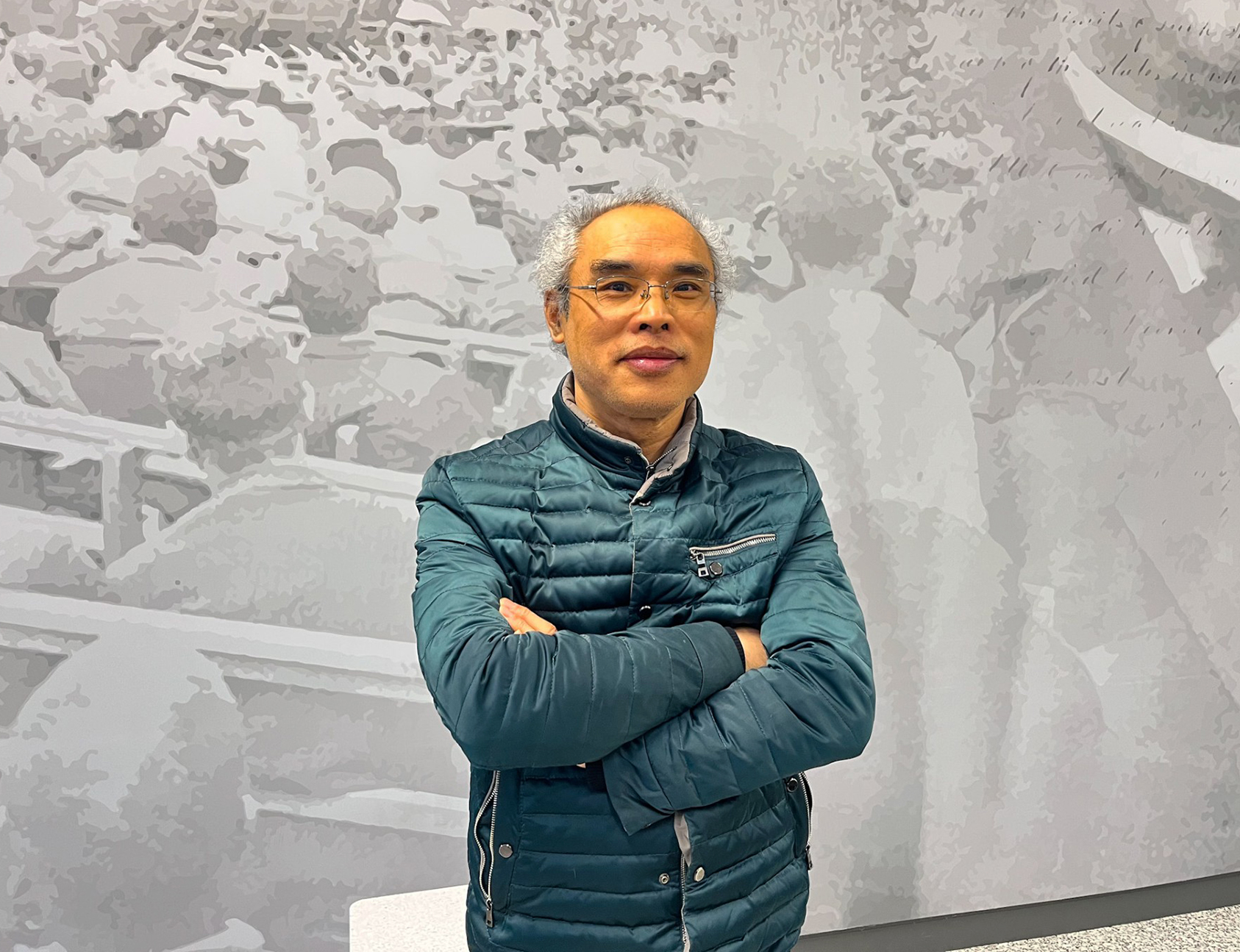
Liu Publishes Breakthrough Materials Science Research
Dr. Congxiao Liu, a mathematics educator and materials modeling expert at Alabama A&M University, has achieved a major milestone with the publication of a paper in Acta Materialia, a leading peer-reviewed materials science journal.
The research, conducted over the past two years in collaboration with Professor Liping Guo at Wuhan University in China, explores how radiation affects the microstructure of ferritic/martensitic steels, materials used in advanced nuclear applications.
Originally from Xiangtan, Hunan Province, China, Liu earned a bachelor’s degree in physics from Jilin University in 1989, a master’s in physics from Peking University in 1995, and both a Ph.D. in physics and a Ph.D. in mathematics from the University of Alabama, Tuscaloosa. He has taught mathematics at Alabama A&M for 17 years.
The collaboration with Guo dates back to 2009 when Liu visited Guo’s lab at Wuhan University during its early stages. Since then, Liu has handled the theoretical modeling while Guo conducts experiments, resulting in multiple publications in respected journals, including Applied Physics Letters and Applied Surface Science.
Two years ago, the team began studying irradiation effects on ferritic/martensitic steels. Liu developed a system of differential equations to model the evolution of radiation-induced dislocation loops in the material. The work led to the first phase diagram showing distinct regions for mobile and immobile loops and predicting transitions at 350-400°C. The model links microstructural changes to irradiation dose, temperature, and mechanical properties like hardening.
“This research allows scientists to better predict and control radiation damage in steels, which is critical for nuclear applications,” said Liu.
The path to publication was challenging. Realizing the importance of their result, they did not publish the experimental and theoretical parts separately as people usually do. Rather, they combined both work in one paper. After multiple rejections from journals and more than a year of revisions, it was accepted in Acta Materialia, a top-tier journal in the field (IF 9.3) recognized as a “gold standard” for high-impact, in-depth research on processing, structure, properties, and performance of inorganic materials.
“Initially, the process was painful and stressful,” said Liu. “But we never gave up because we knew the value of our work.”
The research is ongoing. The next step is to apply the model to other materials and continue advancing predictive materials science. Liu emphasizes collaboration in modern research.
“Another thing I want to share with the AAMU family, especially our students, is that today, good research often comes from working with peers. We want access to advanced facilities and we want to be trained to carry out high-quality research. We want to learn great ideas from outside. All of this requires collaboration and teamwork. If you want more, you have to bear more. That is just the reality, I guess.”